The Well of Kvasir: When the RAG Pipeline Learned to Listen
· 9 min read

How a single email from a candidate revealed four distinct failures in four distinct layers — and why Separation of Concerns was the only way to fix them
Articles on Opik LLM observability and prompt optimization
View All TagsHow a single email from a candidate revealed four distinct failures in four distinct layers — and why Separation of Concerns was the only way to fix them
Three near-zero-cost interventions that improved our civic RAG pipeline more than any model change could
How streaming, threads, and two small buttons turned a Q&A tool into a learning system
How 60 social media screenshots became a searchable civic memory in one afternoon
"It looks impossible - but it's a hackathon. Cheers!"
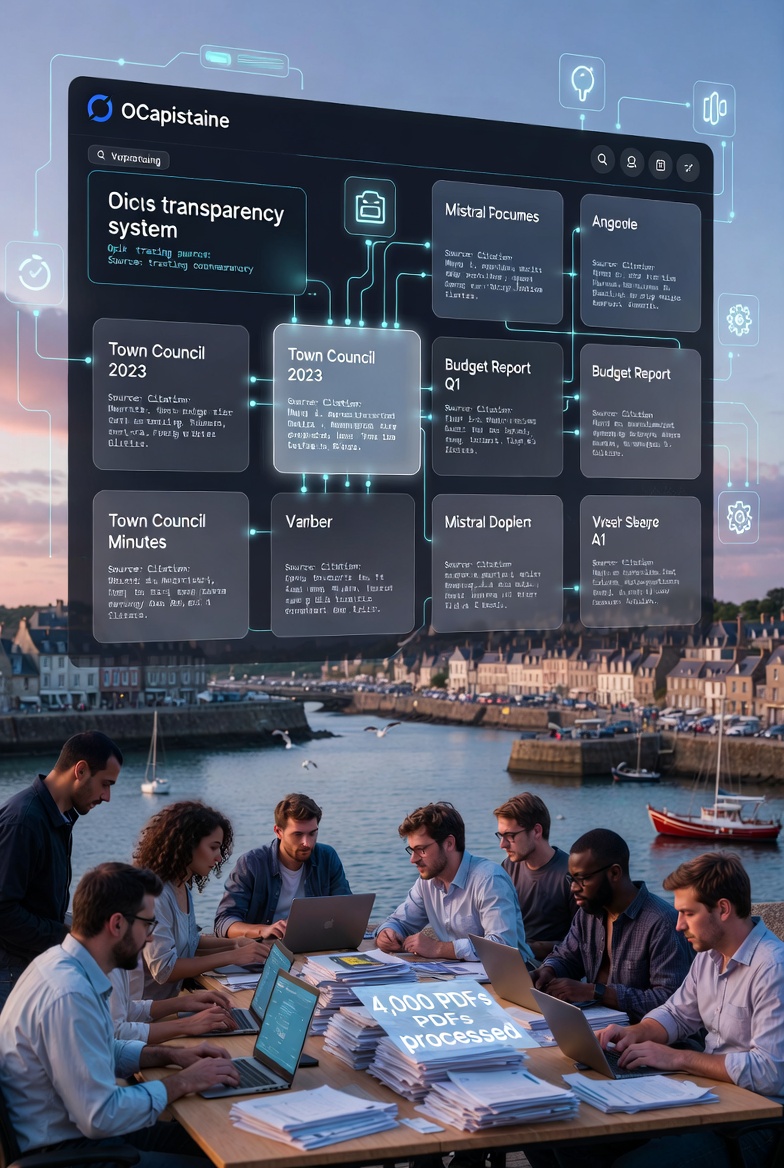
This is the story of OCapistaine, a civic transparency AI built during the Encode "Commit to Change" Hackathon. It's a story of blocked pipelines, strategic pivots, 4,000 municipal PDFs, and the belief that AI can help citizens understand their local democracy.
Spoiler: We shipped it. Barely.
Sprint planning call between Johnny (@jnxmas) and Victor (@zcbtvag) to align on the Sunday midnight deadline. Key decision: pivot to Mistral Document AI + Batch + Agent for a rapid RAG prototype.
Quick catch-up between Johnny (@jnxmas) and Victor (@zcbtvag) covering Opik integration progress and OCR pipeline challenges.
Johnny showcased recent progress on Opik prompt optimization. A new architecture is in place where prompts are no longer hardcoded but managed via an Opik Prompt Library. The "Charter Validation" prompt has already been optimized using this system.
A new mock-up feature can automatically generate contributions (even with violations) from existing meeting reports. The goal is to create a robust dataset to test and improve the validation agent. However, this auto-generation currently produces repetitive content - a challenge that will need addressing by identifying and aggregating duplicate contributions.
Today we completed a major architectural milestone: modular prompt management for Forseti461. Each feature now has its own versioned prompt in Opik, enabling independent optimization and A/B testing.
From a single monolithic prompt to a clean separation of concerns — each Forseti feature can now evolve independently while sharing a common persona.
Forseti461 is an AI agent that automatically moderates citizen contributions to participatory democracy platforms — approving only concrete, constructive, locally relevant ideas while rejecting personal attacks, spam, off-topic posts, or misinformation, and always explaining decisions with respectful, actionable feedback.
This weekend, Facebook reminded us that democracy is fragile. Toxic comments, personal attacks, and off-topic rants flooded discussions about local issues. The signal gets lost in the noise. Citizens disengage. Constructive voices give up.
What if we could protect civic discourse at scale?