The Conversation Loop: When Citizens Teach the AI What Matters
· 6 min read

How streaming, threads, and two small buttons turned a Q&A tool into a learning system
Citizen technologies and open source for the public good
View All TagsHow streaming, threads, and two small buttons turned a Q&A tool into a learning system

How a single false correction revealed the need for local geographic authority in AI pipelines
How 60 social media screenshots became a searchable civic memory in one afternoon
How TRIZ and Theory of Constraints guided us from a 120-second timeout to a zero-LLM first pass
Between December 2025 and February 2026, we ran an experiment. We opened a participatory platform — audierne2026.fr — and invited the 3,600 inhabitants of Audierne-Esquibien to co-write a municipal programme. Anonymous forms, public discussions on GitHub, full traceability from submission to integration.
36 citizens contributed. That's roughly 1%.
A hybrid approach that uses regex for transcripts, LLMs for general documents, and NLP guardrails for validation
A global lock pattern that makes local AI as reliable as cloud AI—without the costs or data concerns
The daily practice of challenging AI prompts with messy, real-world data
"It looks impossible - but it's a hackathon. Cheers!"
This is the story of OCapistaine, a civic transparency AI built during the Encode "Commit to Change" Hackathon. It's a story of blocked pipelines, strategic pivots, 4,000 municipal PDFs, and the belief that AI can help citizens understand their local democracy.
Spoiler: We shipped it. Barely.
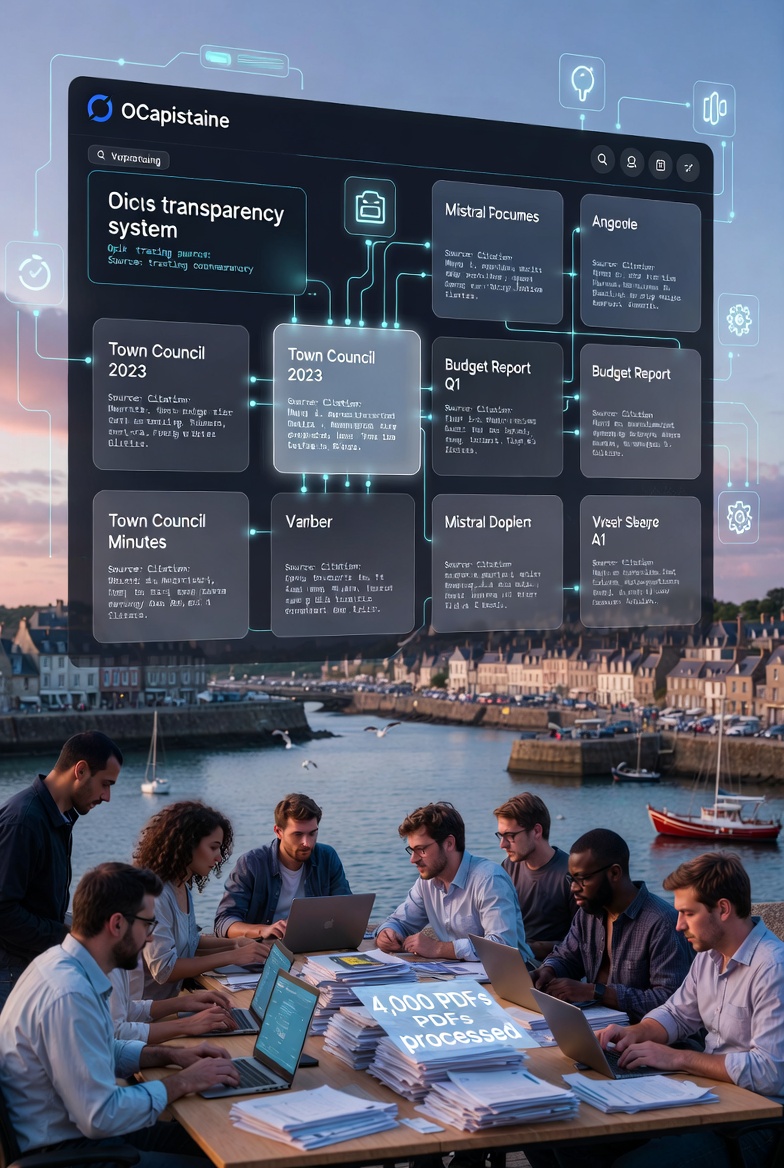
How Ò Capistaine builds trust with citizens and civil servants through measurable AI reliability