O Capistaine ! My Capistaine ! — Une école pour agents IA
· 9 minutes de lecture

Où : comment trois ans d'infrastructure et trois mois d'IA civique nous ont menés au Cercle des poètes disparus — et pourquoi les yawps sont sur le point de commencer
Articles on AI, machine learning, and related technologies
Voir tous les tagsOù : comment trois ans d'infrastructure et trois mois d'IA civique nous ont menés au Cercle des poètes disparus — et pourquoi les yawps sont sur le point de commencer
Three near-zero-cost interventions that improved our civic RAG pipeline more than any model change could

Comment une seule fausse correction a revele le besoin d'une autorite geographique locale dans les pipelines IA
How TRIZ and Theory of Constraints guided us from a 120-second timeout to a zero-LLM first pass
A hybrid approach that uses regex for transcripts, LLMs for general documents, and NLP guardrails for validation
A global lock pattern that makes local AI as reliable as cloud AI—without the costs or data concerns
The daily practice of challenging AI prompts with messy, real-world data
"It looks impossible - but it's a hackathon. Cheers!"
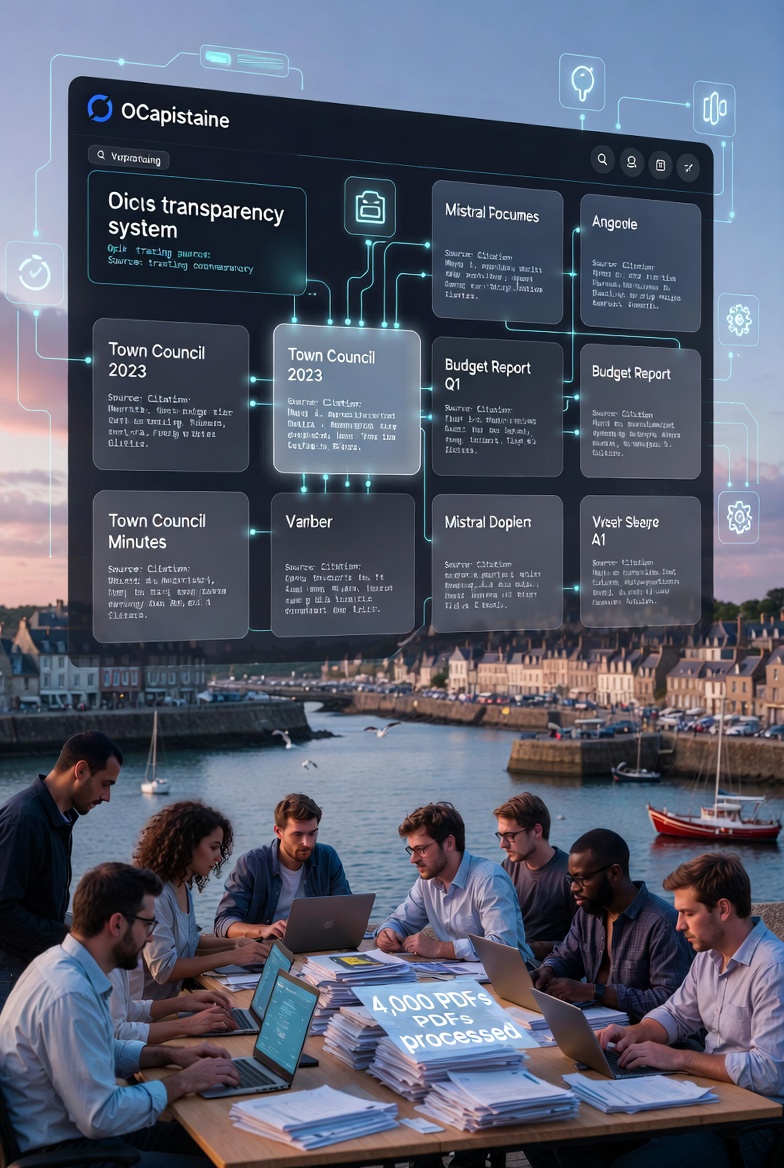
This is the story of OCapistaine, a civic transparency AI built during the Encode "Commit to Change" Hackathon. It's a story of blocked pipelines, strategic pivots, 4,000 municipal PDFs, and the belief that AI can help citizens understand their local democracy.
Spoiler: We shipped it. Barely.
Sprint planning call between Johnny (@jnxmas) and Victor (@zcbtvag) to align on the Sunday midnight deadline. Key decision: pivot to Mistral Document AI + Batch + Agent for a rapid RAG prototype.
Quick catch-up between Johnny (@jnxmas) and Victor (@zcbtvag) covering Opik integration progress and OCR pipeline challenges.
Johnny showcased recent progress on Opik prompt optimization. A new architecture is in place where prompts are no longer hardcoded but managed via an Opik Prompt Library. The "Charter Validation" prompt has already been optimized using this system.
A new mock-up feature can automatically generate contributions (even with violations) from existing meeting reports. The goal is to create a robust dataset to test and improve the validation agent. However, this auto-generation currently produces repetitive content - a challenge that will need addressing by identifying and aggregating duplicate contributions.